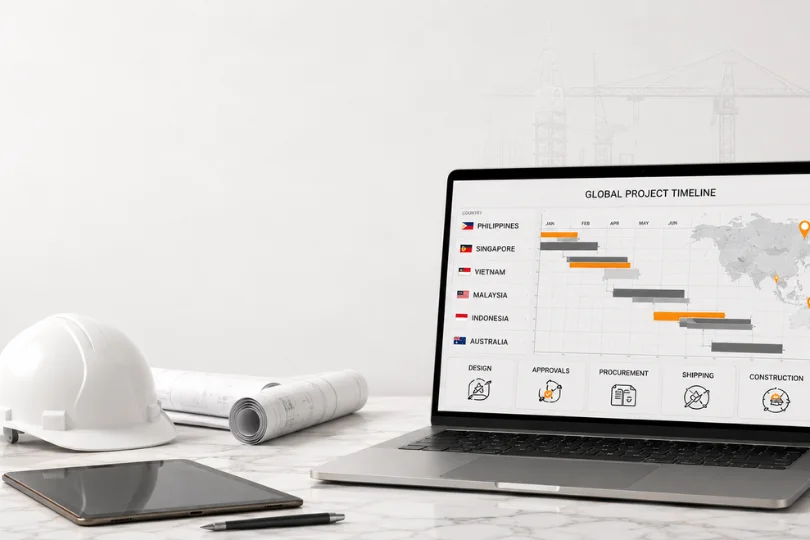
International projects do not usually fail because one team forgot how to use a calendar.
They fail because a delay in one location quietly starts affecting approvals, procurement, resources, and decisions somewhere else.
Managing timelines across countries is less about tracking dates and more about coordinating decisions, dependencies, and resources across multiple markets.
And the cost of poor coordination is not small. Recent research from the Project Management Institute found that only half of construction projects fully succeed, while 37% only partially deliver their expected results and 13% fail outright.
In cross-border programmes, those inefficiencies tend to spread quickly once delays begin affecting several teams, markets, and approvals at the same time.
The more countries involved, the more a timeline depends on alignment, not just effort.
In a single-market project, a delay can already be expensive. In multi-market projects, it also becomes contagious.
One missed approval can delay supplier releases elsewhere. A late design update in one market can affect procurement schedules in another. A bottleneck involving one shared specialist can quietly slow several workstreams simultaneously.
That risk becomes even harder when teams are managing several active projects at once.
In multi-project delivery environments, performance can be limited by the most overloaded resource. When too many tasks compete for the same people, teams are forced to constantly switch priorities instead of completing work efficiently.
In simple terms, when too many tasks compete for the same people, teams are forced to constantly switch priorities instead of completing work efficiently.
That creates:
That is the real issue.
Cross-border timelines do not slip only because tasks run late. They slip because dependencies, decisions, and capacity are connected in ways teams usually notice only after the delay has already spread.
The instinct in complex programmes is often to add more meetings, more reports, and more updates. That usually creates noise, not control.
Global project management guidance consistently points toward a simpler approach: clear expectations, shorter reporting cycles, and centralized systems where teams can see the same priorities, deadlines, and risks in real time.
Because timeline control is not really about how much reporting happens.It is about whether the right people can see the right problem early enough to do something useful about it.
In other words, better visibility beats louder project management.
One of the most common causes of delay in global projects is poor dependency management. Dependencies are the activities that cannot move forward until another task is completed first. And in international delivery environments, there are usually a lot of them.
A permit approval may affect procurement. Procurement may affect fabrication. Fabrication may affect shipping. Shipping delays may affect installation schedules in another market entirely.
This is where timelines quietly get into trouble. The schedule was treated like a static document instead of a live map of what can actually break next.
In cross-border projects, dependencies need constant review, early escalation, and active coordination across teams and time zones. Because what looked manageable last week can quickly become a regional delay once several markets are involved.
Projects rarely stall because of the schedule. Delays often occur when critical approvers, specialists, or decision-makers are shared across multiple projects, regions, and stakeholders.
As these resources become overloaded, work queues grow, response times increase, and project timelines begin to slip. This challenge is especially common in global programmes where the same teams support multiple countries simultaneously.
So when a project says it is “slipping,” the better question is often this: Is the schedule unrealistic, or is an overloaded team creating a bottleneck that slows everyone down?
Delays are easier to manage when teams act early, plan realistically, and monitor progress closely before issues become formal schedule problems.
Many delays begin with:
Not one dramatic event at the very end. That is an important reminder for international delivery.
The goal is to stop normal project friction from becoming an official delay in the first place, which is admittedly less dramatic but much better for delivery.
The teams that keep global timelines moving usually do a few things consistently well:
The point is not to remove every possible delay. It is to stop one delay from becoming everyone’s delay.
International timelines are harder to manage because projects do not just move across tasks. They move across borders, approvals, suppliers, dependencies, teams, and shared constraints.
That means delay prevention depends less on one perfect master schedule and more on stronger visibility, better dependency management, realistic resource planning, and earlier coordination across markets.
Because in global projects, the most dangerous delay is usually not the first one. It is the one nobody realizes is already spreading.
JCVA’s Project Management team helps clients improve schedule visibility, reduce cross-border coordination risk, and align project decisions across planning, procurement, and execution. Through integrated project controls and technology-enabled monitoring, we help teams manage complex delivery environments with greater clarity and fewer avoidable delays.

We manage risks, build strong stakeholder relationships, and deliver solutions that reflect global best practices, backed by deep local industry knowledge.
If you're looking for a reliable partner to bring your vision to life, JCVA is here to build it with you.