In the first half of 2026, more than two-thirds of Metro Manila’s office deals, by floor area, were in green-certified buildings. Certification has become part of the deal. In the Philippines, there are three main systems to choose from: BERDE, LEED and EDGE. Each one pays off differently. One can help you win a multinational tenant. Another can help you secure a green loan. Another can earn you a local tax break. Done right, any of them can also lower your operating costs and support your ESG reporting. So which one is right for your building?
There is no single best certification. Choose the system your project already has to answer to, such as a tenant, parent company, lender or city. If no one requires one, choose the system your design is closest to meeting. A feasibility study across the three shows you which. LEED is recognized worldwide and is often required by US multinationals and BPO tenants. EDGE, from the World Bank Group’s IFC, measures savings in energy, water and materials, and Philippine banks use it for green building loans. BERDE is the Philippine Green Building Council’s system, recognized by the Department of Energy. Some cities, such as Pasig and Mandaue, link tax incentives to it. Decide at inception, before design begins.
The three answers conflict because each team is thinking of a different audience. Before comparing points and fees, list who will look at the certificate. It might be a tenant, a lender, a city hall or your own board. It also helps to be clear on what a certificate tells them. Ar. Butch Dariel Cruz Nera, Sustainability Managing Director of JCVA Terra, the sustainability arm of JCV & Associates (JCVA), puts it simply. “Think of the nutrition facts on a carton of milk,” he says. “Certification does the same for a building. It shows how efficiently the building uses energy, water and materials.”
Certification is a choice. The Philippine Green Building Code and the Department of Energy’s energy efficiency rules still apply at permit stage for larger buildings. A certificate shows your building goes beyond those minimums.
Each system answers to a different body, checks a different scope and costs a different amount to certify. Use the table to see which one your tenants, lenders and city are likely to recognize, then read the section on each system below.
| BERDE | LEED | EDGE | |
| Who runs it | The Philippine Green Building Council (PHILGBC) runs it. | The US Green Building Council runs it, and GBCI certifies projects. | The World Bank Group’s IFC runs it, and licensed providers such as PGBI certify projects. |
| What it checks | It scores the building across categories such as energy, water and materials, once minimum requirements are met. | It awards points across categories such as energy, water, materials and indoor air, once required basics are met. | It checks one thing: whether the design saves at least 20% in energy, water and materials compared with a typical building. |
| How it rates | Buildings earn 1 to 5 Stars. • One Star means the building meets BERDE’s minimum requirements and earns a basic score. • Each added star means a higher share of the available points. • Five Stars is the highest rating PHILGBC gives. | Buildings earn one of four levels, based on points out of 110. • Certified (40 to 49 points) covers the basics. • Silver (50 to 59) and Gold (60 to 79) shows stronger performance, and • Gold is the level clients and lenders often ask for. • Platinum (80 or more) is the top level. | Buildings earn one of three levels. • EDGE Certified means at least 20% savings in energy, water and materials. • EDGE Advanced raises the energy savings to 40% or more. • EDGE Zero Carbon adds renewable energy or carbon offsets to cover the rest of the building’s energy use. |
| When it’s assessed | A building can be rated at design, construction or operation. | New buildings are reviewed after design and after construction. Existing buildings can certify on operations. | The design is certified first, then an audit confirms the finished building. |
| What certification costs | PHILGBC quotes its fees after you register. | Registration costs USD 1,350 to 1,700, and certification starts at about USD 3,200. | Through PGBI, registration costs USD 200, and certification starts at USD 3,000 for buildings under 5,000 m². |
| Who recognizes it here | The Department of Energy recognizes it as the national voluntary rating system. Pasig and Mandaue link tax incentives to it. | US multinationals and BPO tenants often require it. | Banks use it for green building loans, and IFC uses it in its own financing. |
Start with requirements, then look at your design. If a tenant, parent company, lender or city already names a system, that requirement usually decides it. If no one does, the right system is the one your design and materials are closest to meeting.
Ar. Nera sees both situations. “Some clients come to us already decided: this is our rating system, we want LEED, we want Gold. Others have no idea yet.” For the second group, JCVA Terra runs a feasibility study across BERDE, LEED and EDGE. It shows what the project already meets, what still needs proof and what closing the gap would cost. Many clients find they are closer than they think. The market has caught up, and materials that met LEED’s requirements ten years ago are now widely available.
“Many materials on the market are already compliant. Clients often aren’t aware that they’re already compliant.” (Ar. Butch Dariel Cruz Nera)
LEED is the system clients ask about most. “LEED is one of the most marketable, because it’s recognized worldwide,” Ar. Nera says. US companies with green building commitments at home tend to apply them to their offices and suppliers here. “Most US companies, especially BPOs, automatically require at least LEED.”
Market data points the same way. In a 2024 JLL survey, 87% of Asia Pacific occupiers said they target fully green-certified portfolios by 2030. In Metro Manila, Colliers expects green-certified buildings to grow from 39% to 43% of the office stock by 2030. If you plan to lease to multinationals, ask which system and level they require before design starts.
Timing matters too. LEED v5, launched in 2025, puts far more weight on cutting carbon, from the energy a building uses to the materials it is built with. About half its points now relate to carbon. Commercial projects can still register under the older LEED v4.1 until 30 June 2027. Version 4.1 is familiar to Philippine design teams and suppliers. Version 5 lines up better with the carbon targets many multinationals now report against.
EDGE asks for at least 20% modeled savings in energy, water and materials against a typical building. EDGE Advanced raises the energy savings to 40%. It focuses on three measurable savings targets rather than a long list of credits.
Some Philippine banks offer green building loans and ask for a recognized certification. One of the country’s largest banks pairs its green building loans with technical help to meet EDGE’s requirements. Its green financing framework shows how this works in practice. It counts a building as green at EDGE Certified, EDGE’s entry level. For LEED, it asks for Gold. For BERDE, it asks for 4 Stars. In other words, EDGE’s first level satisfies this lender, while the other two systems need a higher rating.
IFC, the World Bank Group’s investment arm, has tied a sustainability-linked loan to EDGE Zero Carbon targets. The borrower is one of the country’s largest property developers, and the targets cover its offices. If your company plans to finance a project through green loans or green bonds, expect lenders to measure it against EDGE. EDGE savings are modeled at design and confirmed by an audit after construction. The savings you actually see still depend on how the building is run.
IFC explains how EDGE certification works, from its three savings targets to its three levels. (Video: IFC EDGE)
BERDE is the Philippine Green Building Council’s system, and the Department of Energy recognizes it as the national voluntary rating system. It is built for Philippine conditions, and it first checks that a project meets national and local laws before rating anything beyond them.
Its clearest financial benefit is local. Pasig’s 2016 ordinance gives a real property tax credit of 2% to 10%, depending on the star rating. Mandaue’s 2023 ordinance offers a real property tax discount of 5% at 1 Star up to 25% at 5 Stars for voluntarily certified buildings. Other cities, including Quezon City, have their own green building rules, so check what applies where you build.
“BERDE makes sense when your building serves the Philippine market and your city recognizes it,” Ar. Nera says. “It’s built around our own laws and conditions, and the process is handled locally. In cities like Pasig and Mandaue, it can also lower your real property tax. If your tenants or investors are global, we usually look at LEED or EDGE alongside it.”
When tenants and lenders recognize different systems, JCVA Terra does not ask the owner to guess. The work starts before the client signs on. The team reviews the documents the client already has and says plainly where the project stands. The feasibility study then checks the design against each system. It shows what each would ask, what is already met and what each gap would cost in fees and design changes. Proposals also include a payback estimate, so the owner can weigh the premium against operating savings.
If there are no drawings yet, JCVA Terra runs a workshop with the design team. It covers the intent behind each requirement, such as why efficient lighting matters. Once a system is chosen, the team does more than hand over a checklist. “We don’t just give clients a list of requirements,” Ar. Nera says. “We show them how to actually do it, and we do the reporting with them.”

A feasibility study starts with what is already in place: the plans, the specifications and the materials on order.
The best time to choose a certification is at inception, before anyone draws. That is when sustainability goals can shape the design, instead of being fitted in later. “The ideal time is inception, even before the architects and engineers come in,” Ar. Nera says. “That’s when the whole team can set the sustainability goals together, so they shape the design from the start. If certification comes in midway, the building is already designed. Anything that isn’t compliant becomes a change, and every change becomes a variation in the budget.”
In his experience, design is the heaviest stage for every system. That is where the team calculates energy savings across the building envelope, lighting, air-conditioning efficiency and fresh air.
“Sustainability shouldn’t be an add-on. It should be part of the design from day one.” (Ar. Butch Dariel Cruz Nera)
Once design is approved, construction is mostly implementation and audit. Supplier documents can still slow things down, because materials claimed as sustainable need third-party proof that they comply, sometimes from a partner abroad.
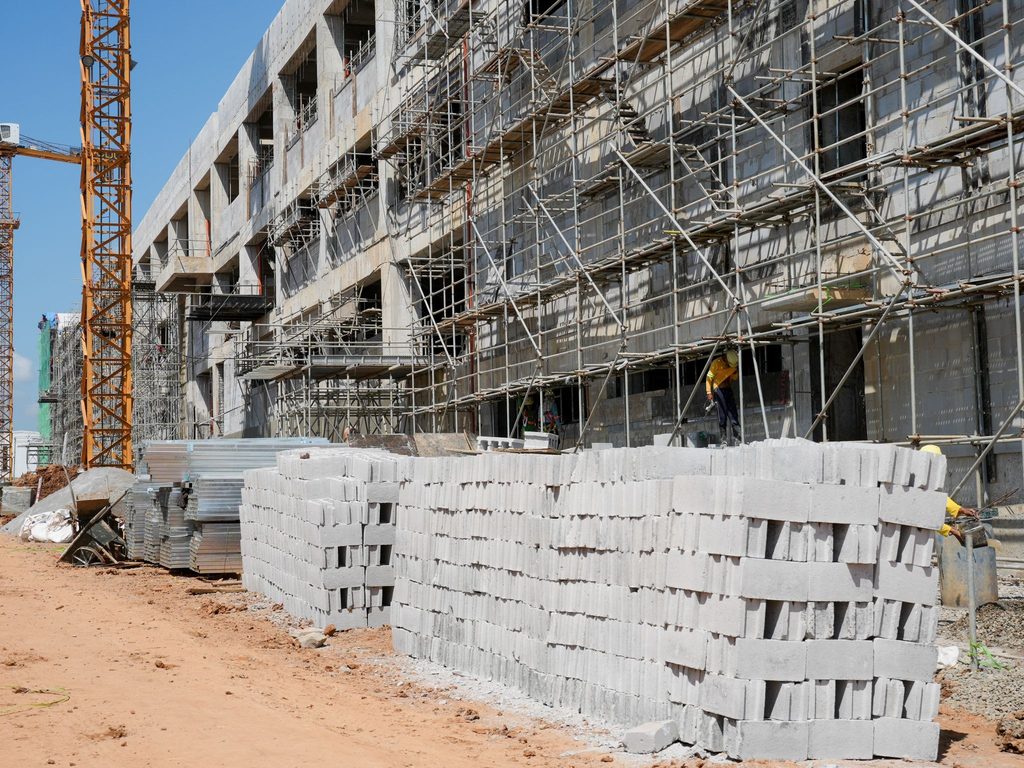
Materials claimed as sustainable need third-party proof before they count toward certification.
Even experienced design teams need this work on every new project. “Many architects have been part of a LEED project before,” Ar. Nera says. “Even so, every project still needs guidance. Energy performance changes with the location, the climate, the size of the building and how many people use it. Our job is to filter what the project actually needs to comply.”
A late start is not always lost. Some clients come to JCVA Terra at about 20% of construction, and parts of the plan already comply. JCVA Terra checks the mandatory requirements first, then tells the client plainly whether certification is still achievable.

Certification goals are easiest to build in while the design is still on paper.
Certification does cost more up front. “When it comes to price, yes, there’s a premium,” Ar. Nera says. “The misconception is that it will cost them now with no return on investment. There is a return, usually within a few years, and we show it in a study whenever we propose a project.”
The premium is usually smaller than owners expect. The World Green Building Council found most certified buildings cost 0% to 4% more than conventional ones. The return comes from operations and from the market. A meta-analysis by Dalton and Fuerst looked at certified buildings, mostly in US and European markets. On average, they rented for about 6% more and sold for about 7.6% more.
“There’s a premium, but there is a return on investment, and we show it in a study whenever we propose a project.” (Ar. Butch Dariel Cruz Nera)
Savings depend on how the building is run after handover, and LEED holds owners to it. Under LEED, owners sign an attestation and share the building’s energy and water data with GBCI for five years after certification. The certificate is the start of a commitment, and the owner keeps proving it in operation.
A certificate is only worth something if the building earns it. Marketing a building as green when it isn’t is greenwashing, and third-party certification exists to prevent it. So what happens when a client wants certification but can’t accept any change to the plan? JCVA Terra shows what would need to change and looks for a workaround. “We tell them what it would take and ask whether they’re open to a workaround,” Ar. Nera says. “Certification is voluntary, so it only means something if it’s done honestly.” If no workaround is possible, the team says so plainly, before the client spends on fees.
For an owner, the lesson is to budget for changes when you commit to a rating. Agree the target level with your design team early, and give the consultant room to adjust the design. The result is a building that can stand behind its certificate when a tenant, lender or auditor asks.
A certification is chosen once, but the building lives with it for decades. “In the next three years, certification will become more and more stringent,” Ar. Nera says. “It’s no longer just about complying. It’s about how we protect the environment, how we treat our people and how we run our business.”
The pressure is already reaching owners. Listed companies now report on sustainability, and SEC rules adopted in December 2025 phase in climate-related reporting that draws on building energy data. LEED’s newest version puts about half its points on carbon. Tenants and lenders are asking for more each year. So weigh the choice against where your building is heading. Consider:
A Philippine Green Building Council session on how BERDE supports net zero goals in building projects. (Video: PHILGBC, 2022)
Ar. Nera compares good sustainability to an inverter air conditioner. It takes a little longer to cool the room, but it runs efficiently for years. The right certificate works the same way. It may ask more at the start, and it keeps paying back long after the ribbon-cutting.
For the head of sustainability with three conflicting answers, the way forward is to test them before choosing. A feasibility study at inception checks the design against LEED, EDGE and BERDE and prices each gap. It then weighs each option against the tenant’s requirement, the loan terms and the company’s reporting plans. The board gets a recommendation backed by numbers, made before the architect draws a line.
Go through this with your leasing, finance and design leads before design starts. Each item is something JCVA Terra confirms with owners at the start of a project.
☐ Make sure you know who needs to see the certificate, and what they require. A tenant, parent company, lender or city may already name a system and level, such as LEED Gold. That requirement usually decides the choice.
☐ Conduct a feasibility study shows what your design already meets. It tells you which system you’re closest to, and often shows you’re nearer than you think.
☐ You have both costs in hand. Certification fees are only part of it. Ask for the soft costs and the cost of design changes, so the budget holds.
☐ Your team is willing and has agreed to change the design if needed. Without that, certification isn’t the right goal yet, and a credible consultant will tell you so.
☐ Someone ca take ownership of supplier proof and documentation. Materials need third-party proof, which takes time. Name who chases it, so it doesn’t delay the final certificate.
☐ The green building certification choice fits your plans five years from now. Check it against future tenants, financing and ESG reporting, not only today’s requirement.

We manage risks, build strong stakeholder relationships, and deliver solutions that reflect global best practices, backed by deep local industry knowledge.
If you're looking for a reliable partner to bring your vision to life, JCVA is here to build it with you.


 United States
 Australia
 United Kingdom