Industrial growth is quietly reshaping where and how goods are produced, stored, and moved across the country. When people think about construction growth, attention usually goes to airports, railways, or major highways.
But another story is unfolding in the background.
Warehouses, logistics parks, manufacturing facilities, and industrial estates are becoming a larger part of the country’s construction pipeline as businesses strengthen supply chains and expand production.
The available data does not point to a nationwide warehouse boom. There is no official national dataset that measures warehouse supply, vacancy, rents, or completed warehouse floor space.
Instead, the evidence reveals a broader trend.
Larger non-residential projects, growing manufacturing activity, stronger cargo movement, and continued investment in economic zones are creating demand for industrial facilities that support the movement of goods and business operations. Together, these developments show how industrial construction is quietly becoming one of the Philippines’ important growth stories
That being said, larger developments are driving more of today’s construction activity.
The Philippine Statistics Authority (PSA) reported that the value of approved non-residential construction reached ₱278.65 billion in 2025, an increase of 11.1% from the previous year. Floor area also expanded by 11.0% to 24.85 million square metres.
Interestingly, the number of approved projects declined slightly by 0.6%. That tells a different story.
Developers are not simply building more projects. They are investing in larger and more capital-intensive developments. This often means bigger industrial sites that require extensive site works, utilities, mechanical and electrical systems, and supporting infrastructure.
It is important to note that the PSA’s non-residential category includes commercial, institutional, industrial, and agricultural buildings.
The figures should not be interpreted as warehouse construction alone. They do, however, indicate that larger industrial and commercial developments are becoming a more significant part of the construction market.
Growing production creates demand for more than just factory space. Manufacturing remains one of the country’s strongest drivers of industrial construction.
According to the PSA, the volume of manufacturing production increased by 10.2% year on year in May 2026.
The value of net sales also grew by 7.2%, while average capacity utilisation improved to 78.8%, compared with 77.1% a year earlier.
These figures do not automatically translate into new construction projects. However, they suggest that manufacturers continue to expand operations and make greater use of existing production capacity.
As production grows, businesses often require more than additional factory floors. They may need larger storage facilities, loading bays, wastewater systems, offices, truck circulation, and of course, room for future expansion.
Some companies may expand existing facilities, while others choose to locate within industrial parks where infrastructure and logistics connections are already in place.
This highlights an important point. Industrial construction is rarely limited to a single building. It usually involves an entire ecosystem of supporting facilities that help production operate efficiently.
The expansion of the industrial ecosystem means greater demand for facilities that keep supply chains moving. Industrial development depends not only on production but also on the movement of goods. The PSA reported that the transportation and storage sector grew by 4.4% during the first quarter of 2026.
Meanwhile, the Philippine Ports Authority recorded 308.5 million metric tons of cargo throughput in 2025, representing a 6.6% increase from the previous year. Domestic cargo alone increased by 8.84%, reaching 114.09 million metric tons.
Increased cargo movement helps explain why industrial facilities continue to develop near ports, airports, expressways, and major transport corridors.
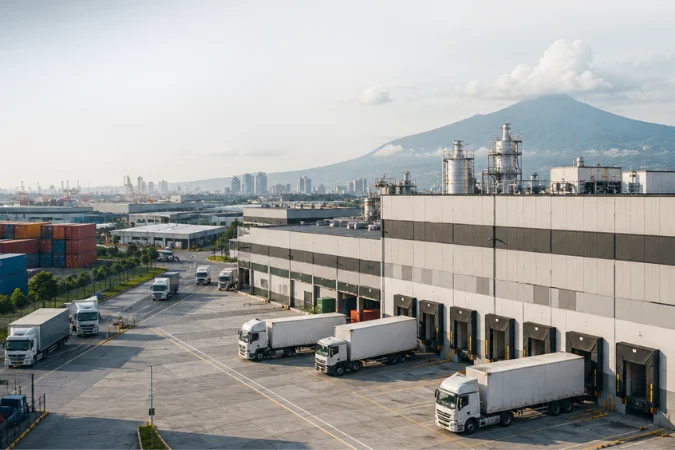
Goods moving through these networks need places to be received, sorted, processed, distributed, and stored before reaching their final destination. That creates demand for warehouses, distribution centres, container yards, cold storage facilities, truck staging areas, and other industrial support infrastructure.
Building on the above, many of these industrial facilities are being developed within or alongside economic zones.
As demand for logistics and industrial infrastructure grows, economic zones are evolving beyond simple manufacturing locations. They are becoming integrated industrial ecosystems where manufacturers, logistics providers, infrastructure developers, and service providers operate together.
From January to July 2026, the Philippine Economic Zone Authority (PEZA) approved 174 new and expansion projects worth ₱151.90 billion.
Of the 174 new and expansion projects approved by PEZA from January to July 2026, the following categories are most relevant to industrial development:
The remaining 44 projects approved by PEZA come from mixed sectors, namely IT-BPM, domestic market, tourism, and utilities.
This influx of investments reflects how industrial growth is supported by multiple types of development.
A manufacturing company relies on serviced land, roads, logistics providers, warehouses, wastewater systems, and reliable power before production can begin. Industrial growth, therefore, depends on the surrounding ecosystem as much as the factory itself.
It is also important to recognise what these figures represent. PEZA approvals indicate planned investments, not completed buildings or active construction sites. Even so, they provide valuable insight into where industrial development is being prepared and how different types of projects are working together to support long-term economic growth.
The growth of industrial ecosystems is becoming more visible in certain parts of the country.
Central Luzon is one of the clearest examples, supported by its transport links, established industrial corridors, and concentration of manufacturing and logistics-related developments.
One example is the 24-hectare industrial park in Mexico, Pampanga, which is intended to accommodate manufacturing, warehousing, and logistics-related businesses. The site has access to major expressways, Clark International Airport, and Subic Bay, placing it within one of the country’s established industrial corridors.
Another recent example is the proposed Pax Silica Industrial Hub in New Clark City. Announced in 2026 under the Luzon Economic Corridor, the project is planned as a 1,620-hectare industrial zone focused on advanced manufacturing, semiconductors, artificial intelligence, and related industries. The project remains in the proposal and planning stage, with implementation details still being developed.
These projects do not suggest that industrial growth is occurring uniformly across Central Luzon or the rest of the country. Instead, they illustrate how large-scale industrial developments continue to be concentrated in locations with existing infrastructure, transport access, and available development land.
On that note, industrial investment is spreading across the Philippines, albeit unevenly across regions. Industrial development is no longer concentrated entirely in Luzon.
Between January and July 2026, PEZA approved 141 projects in Luzon, 22 in the Visayas, and 11 in Mindanao.
Although Luzon continues to receive the majority of investments, the figures indicate that opportunities are gradually emerging in other parts of the country. As referenced earlier, regional expansion is being driven by locations with improving transport links, expanding ports, active manufacturing industries, and available industrial land.
For developers and investors, this reinforces the importance of evaluating each region on its own strengths rather than assuming demand is uniform across the Philippines.
Approved investments point to where future industrial activity is taking shape.
The Board of Investments (BOI) approved more than ₱1.5 trillion in investments during 2025, with ₱230.06 billion allocated to transportation and storage projects. During the first half of 2026, the BOI approved 124 projects worth ₱461.84 billion.
Among these were ₱36.25 billion in air and water transport projects and ₱7.22 billion in manufacturing investments, with the approved projects expected to generate more than 14,000 direct jobs.
It is important to establish that not every approved project will immediately move into development. However, they do provide a useful indication of where businesses are directing capital and where future industrial construction activity is likely to emerge.
Following this, the next phase of industrial growth will be built through connected facilities, not headline projects.
The Philippines’ industrial construction story is not defined by a single megaproject or one rapidly growing sector. Instead, it is taking shape through the combined growth of manufacturing, logistics, transportation, and economic zones.
Larger non-residential developments all point toward a construction market that is becoming more integrated and operationally focused.
While the available evidence does not support claims of a nationwide warehouse boom, it does show a growing need for facilities that keep businesses producing, storing, and moving goods efficiently. For developers and project owners, success will depend on understanding how industrial facilities fit within the broader supply chain and delivering projects that support long-term operations, not just construction.
High-value industrial developments begin with strong project management.
As industrial facilities become larger and more specialised, successful delivery depends on careful planning, technical coordination, and disciplined project controls.
JCVA’s Project Management services help developers and project owners manage risks, coordinate stakeholders, and keep industrial projects on schedule from planning through completion. Contact us at technical@jcvassociates.ph or visit www.jcvassociates.ph.

We manage risks, build strong stakeholder relationships, and deliver solutions that reflect global best practices, backed by deep local industry knowledge.
If you're looking for a reliable partner to bring your vision to life, JCVA is here to build it with you.