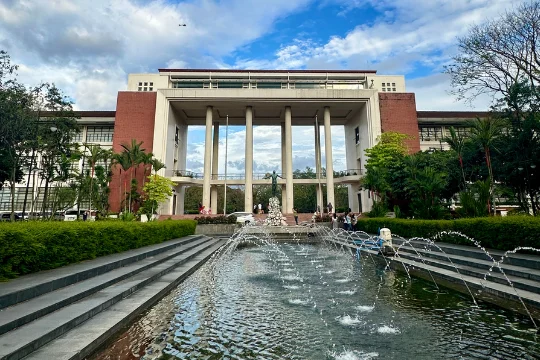
Every classroom represents more than a place to learn.
It is a public investment, a community asset, and during emergencies, often a place of safety.
The Philippines is currently working to address a significant shortage of public school classrooms. According to the Second Congressional Commission on Education (EDCOM II), the country faces a 165,443-classroom backlog, while 122,518 school buildings have already exceeded the Department of Education’s 25-year design life. Without major intervention, more than 51,000 classrooms could be condemned by 2028.
The government has responded by accelerating investments in education infrastructure. In April 2026, the Department of Budget and Management released ₱17.27 billion under the Basic Education Facilities Fund to construct 4,960 new classrooms across the country. The proposed 2026 national budget also allocates ₱44.58 billion for education infrastructure, including funds for new classrooms, repairs, and safer, more resilient school facilities.
Those investments create an important opportunity.
The challenge is no longer simply building more classrooms. It ensures new schools remain safe, functional, and capable of serving communities for decades.
Resilient school infrastructure starts with decisions made long before students enter a classroom.
Building additional classrooms is only part of the solution.
Many existing school facilities were designed decades ago under different standards and now face increasing pressure from larger student populations, changing environmental conditions, and aging structures.
According to EDCOM II, the country’s classroom shortage is compounded by deteriorating school buildings that have already exceeded their intended service life. Addressing the backlog, therefore, requires more than increasing construction volume. It also requires improving how schools are planned, designed, built, and maintained over time.
That places greater responsibility on everyone involved in project delivery.
Quality assurance becomes just as important as construction speed. Engineering systems must work together to support structural integrity, occupant safety, and long-term performance. Lifecycle planning also becomes increasingly valuable because decisions made during design and construction influence maintenance costs, repair requirements, and building performance for decades.
Lifecycle planning refers to designing and managing a building with its entire lifespan in mind, from construction and maintenance to future repairs and eventual replacement.
For public school projects, success should not be measured only by the number of classrooms completed.
It should also be measured by how well those schools continue serving students and communities long after construction ends.
Schools serve multiple roles across the Philippines.
Every day, they provide learning spaces for millions of students. During emergencies, they often become evacuation centers, temporary shelters, and community coordination hubs.
That means school buildings are expected to remain operational when surrounding communities are under the greatest pressure.
UNICEF has emphasized the importance of investing in resilient and inclusive school infrastructure while reducing reliance on schools as evacuation centers whenever possible. Where schools continue to serve this role, facilities should be designed to remain safe, functional, and capable of supporting both education and emergency response.
The importance of that responsibility became clear following the magnitude 7.8 Mindanao earthquake in June 2026.
The need for resilient school infrastructure became especially clear following the magnitude 7.8 earthquake that struck Mindanao in June 2026.
Initial assessments by the Department of Education found that 267 public schools across 14 provinces were affected, with 1,391 classrooms sustaining damage, including 199 that were destroyed. Around 4 million learners experienced disruptions to their classes as schools assessed structural damage and shifted to temporary learning arrangements. In response, DepEd allocated ₱235 million for temporary learning spaces and announced plans to tap its ₱3 billion Quick Response Fund for reconstruction.
While earthquakes cannot be prevented, the extent of damage often depends on how infrastructure is planned, designed, constructed, and maintained.
The Philippines also faces recurring flooding and other natural hazards throughout the year. Together, these events reinforce the importance of building schools that can withstand multiple risks while continuing to serve the communities that depend on them.
Every damaged classroom represents more than a construction loss.
It interrupts learning, affects families, delays community recovery, and places additional pressure on public resources.
A resilient school is not created through stronger concrete alone.
Its performance is shaped by decisions made throughout the project lifecycle, beginning long before construction starts.
Site selection influences exposure to hazards. Structural engineering determines how a building responds during earthquakes. Coordination between architectural, civil, structural, and building services disciplines helps ensure that systems work together rather than independently. Construction quality affects how closely the finished facility matches its intended design.
Project management also plays an important role.
Managing schedules, quality, costs, and construction risks helps ensure that resilience objectives established during planning are carried through to project completion.
Engineering coordination is the process of ensuring that different building systems work together safely and efficiently, rather than competing for space or compromising performance.
Resilient schools result from consistent decision-making throughout planning, design, procurement, construction, and long-term maintenance.
Building resilient schools requires upfront investment, but rebuilding damaged schools often costs far more.
According to UNICEF Philippines, climate-related disruptions cause students to lose up to one month of learning each year, while the Department of Education estimates annual losses of approximately ₱17.98 billion due to schools’ exposure to climate hazards.
Learning disruptions extend beyond the classroom.
Parents may need to adjust work schedules, communities lose access to important public facilities, and governments must redirect funding toward emergency repairs instead of new development.
Global research points to similar conclusions. The United Nations Office for Disaster Risk Reduction (UNDRR) reports that every US$1 invested in resilience can generate more than US$15 in avoided losses and broader economic benefits. Meanwhile, the International Finance Corporation (IFC) found that targeted resilience measures can preserve up to US$8.60 in asset value for every US$1 invested.
Asset value refers to the economic worth of buildings and infrastructure throughout their service life.
For public school infrastructure, resilience helps protect both physical assets and the long-term value of public investment.
Building more classrooms remains an urgent priority for the Philippines.
Building them to last is equally important.
As the country works to address its classroom backlog, investments in resilient school infrastructure can help protect students, support communities during emergencies, reduce future reconstruction costs, and ensure that public resources deliver value for decades.
The recent Mindanao earthquake serves as a reminder that schools are more than educational facilities. They are essential community infrastructure that must remain safe and operational when people need them most.
Investing in resilient schools is ultimately an investment in stronger communities, a more resilient education system, and long-term economic growth.
Ready to deliver resilient school infrastructure?
Delivering quality public infrastructure requires more than completing construction on schedule. It also requires maintaining visibility over project quality, compliance, risks, and performance throughout every stage of delivery. Through JCVA’s Construction Management services, our team provides independent oversight to help ensure school infrastructure projects meet quality standards, protect public investment, and remain built-to-serve communities for years to come.
Reach out to our team at technical@jcvassociates.ph or visit jcvassociates.ph to learn how we can support your next project.

We manage risks, build strong stakeholder relationships, and deliver solutions that reflect global best practices, backed by deep local industry knowledge.
If you're looking for a reliable partner to bring your vision to life, JCVA is here to build it with you.